
Japanese Fashion from Berlin: Between Fabric, Presence and Atelier
Japanese fashion is often understood in the West through its visible signs first: kimono, obi, wide sleeves, special patterns, clear lines. These images are strong. But they only tell a small part of what Japanese aesthetics can mean in clothing.
For us, Japanese-inspired fashion does not begin with the wish to copy traditional forms. It begins with another way of looking at the body, the fabric and the space between the two.
A garment does not need to be tight to have form. It does not need to be loud to create presence. It does not need to show everything in order to say something. This restraint is important to SUSUMU AI: clothing that leaves room — for movement, personality and everyday life.
What does Japanese-inspired fashion mean?
Japanese-inspired fashion is not automatically traditional Japanese clothing. It can take up elements without turning them into costume. It can be guided by principles: wrapping, surface, asymmetry, fabric, calm, freedom of movement and a particular attention to proportion.
European fashion often shapes the body quite strongly. Waist, shoulder, leg and neckline are emphasised, corrected or staged. Japanese aesthetics can open another perspective. Fabric may surround the body instead of constantly tracing it. The silhouette may be more generous. A detail may have an effect without pushing itself forward.
This does not mean that everything has to be wide, plain or severe. It means something quieter: the clothing does not define the whole person. It gives a frame.
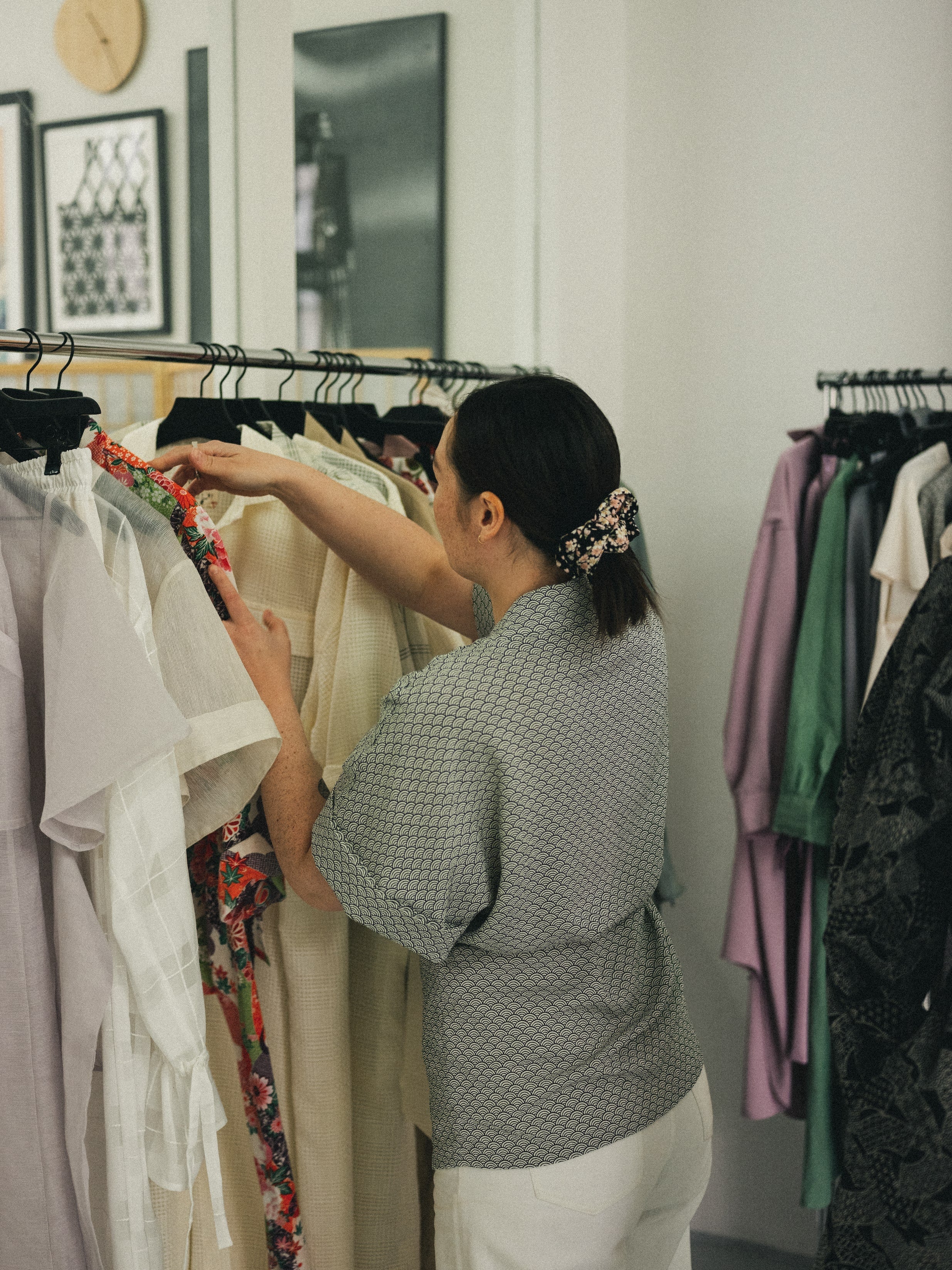
At SUSUMU AI, we translate this attitude into contemporary blouses, jackets, culottes and dresses. A wrap can recall the obi without becoming one. A collar can be inspired by the kimono without becoming a traditional kimono collar. A jacket can carry the calm of a haori and still work in everyday Berlin life.
We show more of this connection on our page about Japanese-inspired fashion from Berlin.
Explore a piece from our Berlin atelier that connects with this topic:
Why we do not design Japanese costumes
When a brand mentions Japanese influences, certain expectations arise quickly. Some people think of cherry blossoms, silk, kimono sleeves or a very visible kind of exoticism. For us, this is exactly where an important distinction begins.
SUSUMU AI does not design costumes. Our clothing should not use another culture as decoration. It should also not pretend that a European everyday garment suddenly becomes traditional Japanese clothing because it carries a pattern or a wrap.
We are interested in translation. What happens when Japanese design principles meet a Berlin atelier, European daily life and modern women? How can a blouse be suitable for work and still have a different calm than a classic shirt blouse? How can trousers feel comfortable without becoming arbitrary? How can a garment be special without looking like disguise?
These questions are quieter than a fashionable quote. But they lead to clothing that remains wearable for longer.
Between Berlin and Japan: a design language, not a collage
Berlin and Japan do not stand next to each other at SUSUMU AI like two decorative references. The connection grows from biography, memory, craft and daily work in the atelier.
Berlin brings a certain directness. Clothing has to live here. It has to work for appointments, weather, bicycles, dinners, work and everyday movement. It cannot only function in a photograph.
Japanese aesthetics brings another kind of attention: a view of the unobtrusive, of material, intervals, proportion and the hand of the craft. Not everything needs to be explained immediately. Some pieces reveal their value only while being worn — in the fall of the fabric, in movement, in the way a collar frames the face.
What comes from this is not loud fusion. It is a quiet design language: clear enough for daily life, special enough for moments in which clothing should give more posture.
How to recognise good Japanese-inspired clothing
Not every garment with an Asian-looking pattern is Japanese-inspired. And not every wide silhouette has depth. If you want to look more carefully, a few questions help.
1. Is the inspiration structural or only decorative?
A printed motif can be beautiful, but it does not make a garment substantial by itself. It becomes more interesting when the inspiration is visible in cut, proportion or the way the piece is worn: a wrap, a surface, a collar, a quiet asymmetry or a silhouette that gives the body space.
2. Does the piece work in contemporary everyday life?
A good garment may carry references. But it should not exist only for a special moment. It should sit well, move well, combine easily and belong to real situations: work, travel, conversations, exhibitions, evenings and ordinary days.
3. Does it respect the craft?
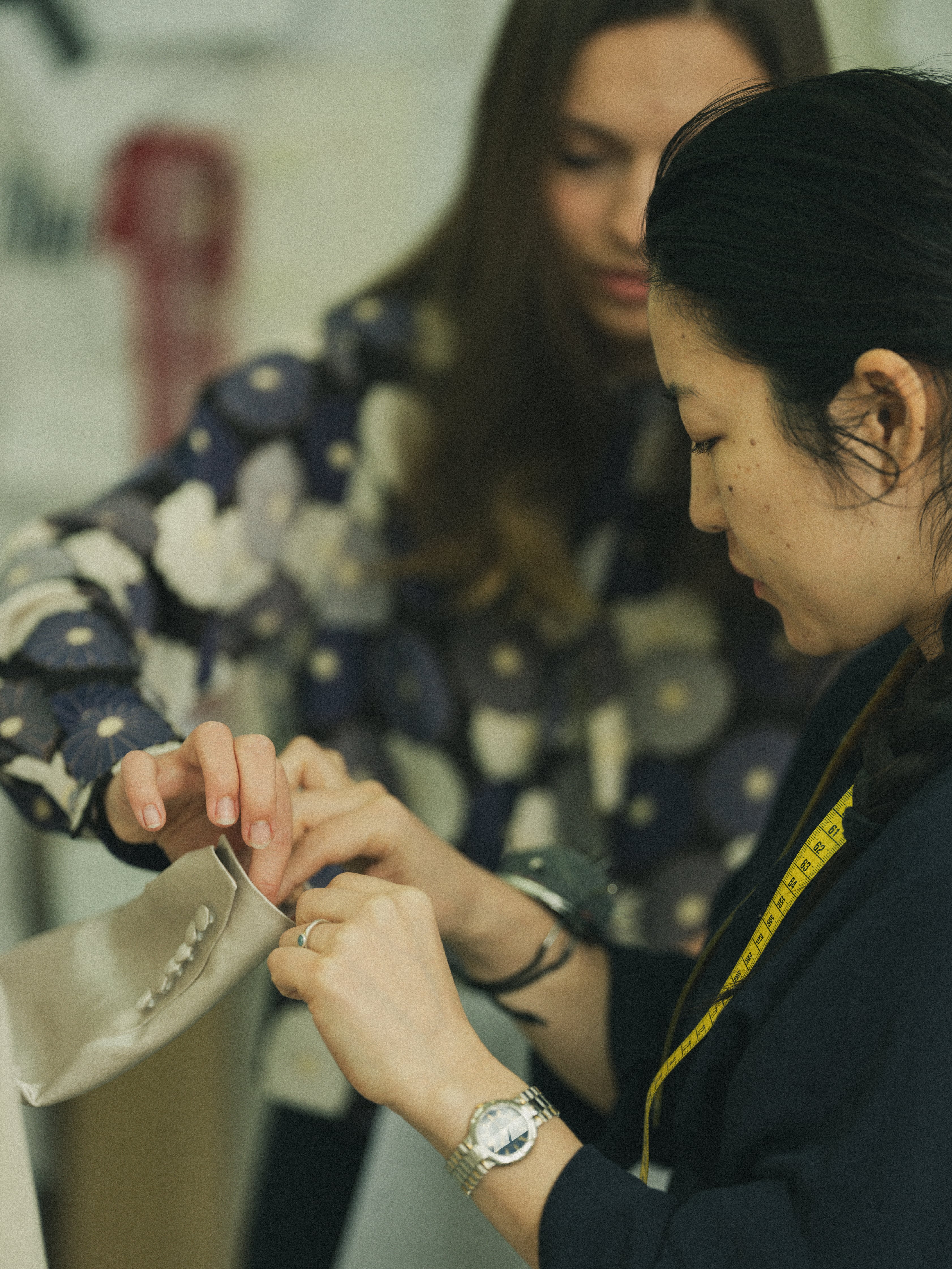
Japanese-inspired fashion can become superficial when only the image is borrowed. The actual value often lies in the making: how a fabric was chosen, how a seam sits, how a collar falls, how a wrap works on the body.
4. Does it leave room for the woman wearing it?
For us, this may be the most important question. Clothing should not say so much about itself that the woman inside it disappears. A strong piece may be visible. But it should not overtake the person.
Examples from the SUSUMU AI collection
The Kimono Collar Blouse shows this thought very clearly. The collar recalls Japanese forms, but the piece remains wearable as a blouse: under a jacket, with quiet trousers, for professional appointments or an evening. It does not look like costume. It gives the upper body a clear line.
The Haori in Japanese Indigo Cotton follows another path. It takes up the idea of an open jacket — generous, light, movable. At the same time, it remains a garment for contemporary combinations: over a simple top, with a culotte or as a quiet accent over a dress.
A culotte can also belong to this language. Not because it has to “look Japanese”, but because it can connect volume, movement and clarity. For many women, this connection of comfort and posture is more interesting than a very narrow, formal business cut.
If you would like to see the pieces together, you can discover the collection.
Why this kind of clothing benefits from consultation
Japanese-inspired fashion often lives through proportion. A collar, a wrap or a wider silhouette can feel different depending on body, height, occasion and the wardrobe that is already there. That is why consultation is not an extra here. It is part of a good buying process.
Sometimes the question is not only the right size. It is: which silhouette supports me? Which fabrics suit my everyday life? How can I combine a special piece so that it is not only beautiful, but worn often?
If you are choosing between sizes, fabrics or silhouettes, we offer personal guidance — directly from our Berlin atelier.
Book a personal consultation in the Berlin atelier
The connection to SUSUMU AI
At SUSUMU AI, we do not think of Japanese fashion as a style template. We think of it as an attitude: less noise, more care. Less costume, more everyday life. Less immediate effect, more relationship to the garment.
Each piece is developed with attention to fabric, cut and the feeling of wearing it. Many garments are made to order, deliberately limited and crafted in the Berlin atelier. This means the focus is not fast availability or fashion mass, but clothing that can accompany a woman over time.
Perhaps this is the most beautiful form of Japanese inspiration: not the visible sign, but the attitude behind it.
Frequently Asked Questions
What is Japanese fashion?
Japanese fashion can include traditional garments such as the kimono, but also modern designs that work with space, wrapping, asymmetry, fabric and reduced form. At SUSUMU AI, it means a contemporary, wearable translation of these principles.
Is SUSUMU AI a kimono label?
No. SUSUMU AI does not design traditional kimonos or costumes. The collection translates Japanese-inspired elements into modern blouses, jackets, culottes and dresses for everyday life.
Can Japanese-inspired clothing be worn for business?
Yes, if cut, fabric and styling remain calm. A blouse with a clear collar, a softly falling culotte or a reduced jacket can work very well in professional settings because they create presence without becoming severe.
Is the clothing made in Berlin?
Many SUSUMU AI pieces are made to order in the Berlin atelier. This allows fabric, construction and fit to be considered with more care than in industrial mass production.
Can I get advice before buying?
Yes. If you are unsure which piece, size or silhouette suits you, you can book a personal consultation.
Conclusion
Japanese fashion does not have to look like a quotation. It can also be felt as an attitude: in respect for fabric, in the space between clothing and body, in a silhouette that does not restrict, and in a design that does not explain everything immediately.
For SUSUMU AI, this is where the connection between Japan and Berlin lives. From aesthetic memory, craft and contemporary everyday situations, garments emerge that stay quiet — and create presence precisely because of that.
If you would like to discover this language for your own wardrobe, you can view the collection or book a personal consultation in the Berlin atelier.