
Article: Winter Business Outfits for Women: 7 Warm, Modern Ideas
Winter Business Outfits for Women: 7 Warm, Modern Ideas
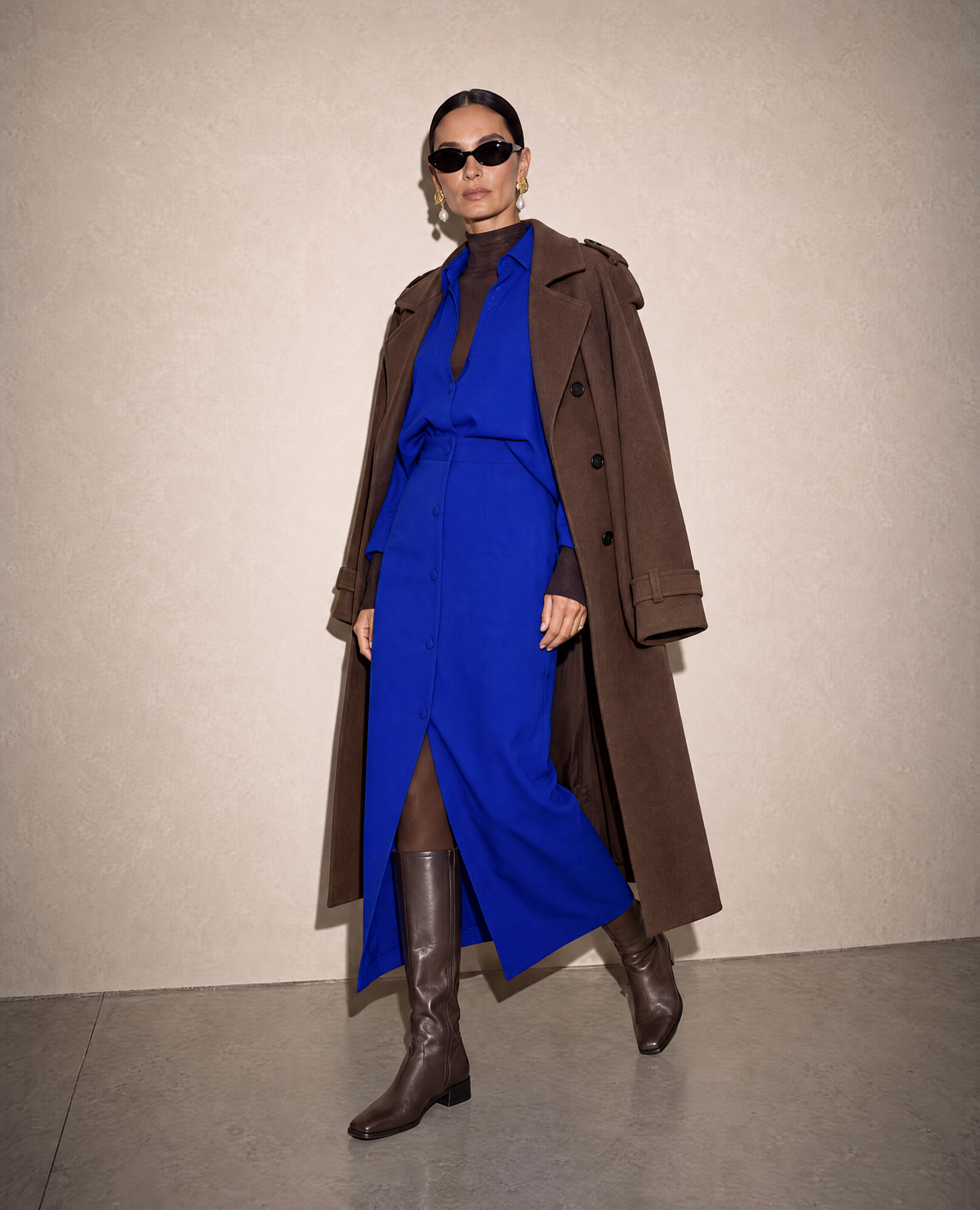
A good winter business outfit has to solve two very different situations. Outside, it needs to protect you from cold, wind and rain. In the office, on a train or during a long meeting, it cannot feel too hot, heavy or restrictive. This change of temperature is where many winter outfits stop working: the thick jumper feels comfortable outdoors but becomes too warm inside, while the elegant blouse looks polished but is not enough for the journey to work.
That is why I do not think of a winter business outfit as one particularly warm garment. I think of it as a system of light layers. Each layer has a purpose and can be removed without the outfit losing its clarity. The result can remain professional, personal and easy to move in — in the atelier, at a client meeting, in the office or while travelling.
SELECTED FOR THIS STORY
Discover the pieces
If you would first like to understand the dress code itself, my guide to business casual for women explains the main principles. This article focuses specifically on the colder months and on combinations that work between winter weather, coats and heated rooms.
If you are mainly looking for the right top, my guide to business casual tops for women complements this winter article with seven specific blouse and knitwear ideas.
The most useful winter principle: three layers with clear roles
For me, a reliable winter outfit has three levels:
- The base layer sits close to the body and helps regulate warmth. It may be a fine vest, a lightweight long-sleeved top or a thin thermal layer that remains invisible under the main clothing.
- The visible middle layer creates the professional character. This is where the blouse, fine knit, waistcoat, culottes, skirt or trousers belong. It should look complete even when worn on its own.
- The outer layer protects you on the way. A coat, scarf, weatherproof shoes and perhaps an additional jacket can be practical while continuing the lines of the outfit underneath.
The visible middle is the most important part. Once you remove your coat and scarf, the outfit should not feel unfinished. A blouse with a clear collar, beautifully draped trousers or a jacket with a calm silhouette can give the look structure without relying on winter accessories.
1. A precise blouse, fluid culottes and a long coat
A blouse with a distinctive collar and wide culottes create a professional foundation without resembling a conventional trouser suit. The contrast is useful: the blouse defines the upper body, while the trousers add movement and space.
In winter, I prefer a thin close-fitting layer underneath rather than a heavy jumper over the blouse. The collar stays visible and the silhouette remains clear. A long straight coat continues the vertical line, while ankle boots with a slim shaft create a quiet transition beneath the culotte hem.
The Signature 2-Way Double Collar Blouse can be styled in two ways and places the focus around the face and shoulders. The SUSUMU AI Culotte provides a calm, fluid base.
2. A fine roll neck, culottes and a structured indoor layer
A fine roll neck is one of the simplest foundations for a winter office outfit. It adds warmth without creating unnecessary bulk under a jacket. The knit should be soft enough for movement but compact enough to create a smooth surface.
With culottes or straight trousers, it becomes a quiet base. Indoors, you can add a short jacket, waistcoat or open layer. An Indigo Haori is not intended to replace a winter coat. It works as a distinctive jacket inside or as an additional layer beneath a generously cut coat.
If the haori or jacket already has a strong textile surface, let the rest of the outfit remain calm. Dark blue, black, ivory or soft grey allow the form to be visible without making too many elements compete.
3. A kimono-collar blouse, straight trousers and slim ankle boots
For an important conversation or presentation, a winter outfit does not have to become more rigid. An unusual collar can create more presence than additional decoration.
The Kimono Collar Blouse frames the upper body with its deep, clean neckline. Straight dark trousers and slim ankle boots keep the combination focused. A lightweight base can be worn underneath as long as it does not appear unintentionally at the neckline.
If you wear a scarf, I would remove it after arriving. A voluminous scarf and a distinctive collar both shape the same area of the body. Indoors, allow the blouse to do that work on its own.
4. A blouse, waistcoat and wide trousers for changing temperatures
A waistcoat is particularly useful when different rooms have very different temperatures. It keeps the torso warmer while leaving the shoulders and arms free to move. It can also give a soft blouse more structure.
With wide trousers, the waistcoat needs a clear ending. A shorter style reveals the waistband. A longer style needs a clean edge or opening so that it does not rest heavily on the trousers and create extra volume. Under a coat, a waistcoat is often easier to wear than a thick blazer.
This combination works well on days with several stages: the journey to work, time in the office, a meeting and an evening appointment. You can remove the coat and scarf and later open the waistcoat without rebuilding the entire outfit.
5. Tonal dressing in navy, black or burgundy
Tonal winter outfits look calm because every layer does not introduce another hard colour boundary. The shades do not need to match exactly. Navy can be combined with denim blue, black with charcoal, and burgundy with a deeper red.
To prevent the outfit from looking flat, vary the surfaces. A smooth coat, fluid trousers and a matt knit each react differently to light. These differences create depth without disturbing the professional impression.
I would choose one deliberate focal point: a distinctive collar, a Japanese textile, a clear bag or a defined shoe. One accent is enough. The quietness of the whole look is part of its strength.
6. A dress or jumpsuit with a fine layer underneath
A dress or jumpsuit can be very practical in winter because the visible silhouette is already complete. Warmth is then added underneath and over it. A fine roll neck can work under a sleeveless piece, while a long-sleeved design may only require an invisible base layer.
Make sure the underlayer does not appear at several different points or create folds. The garment above should still move freely. Add a coat, opaque tights and boots for the journey. Once indoors, you are left with a complete look that needs no further styling decisions.
This approach is particularly helpful on mornings when you want to make fewer choices. A one-piece garment reduces the number of visible transitions and therefore the number of places where colours or proportions can become unsettled.
7. A winter business outfit for a creative profession
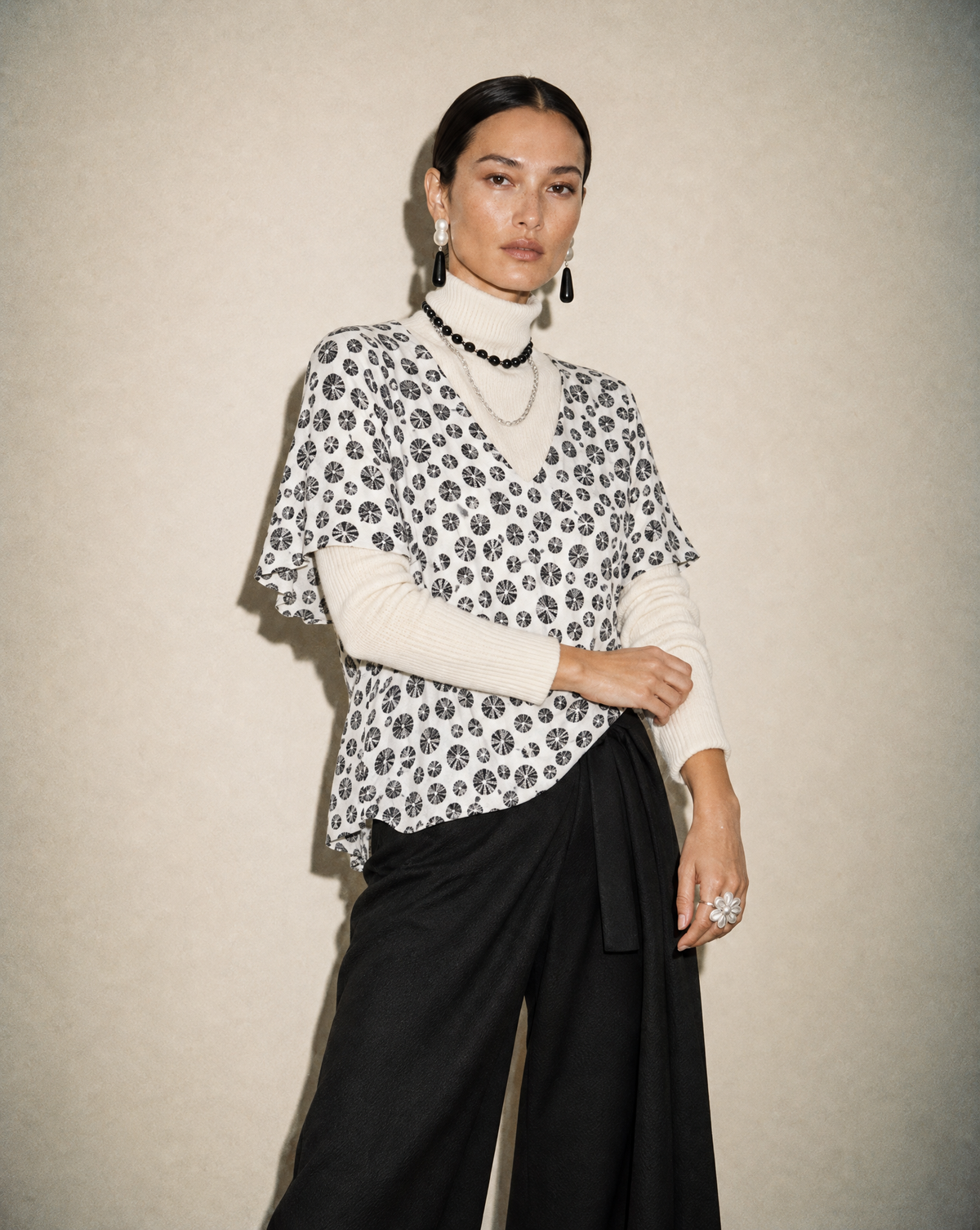
In a creative working environment, an outfit can show character. That does not mean every layer needs to be expressive. One strong shape or a distinctive fabric is usually enough.
For example, combine a patterned blouse with plain wide trousers and a quiet coat. Or wear a strong haori over a dark roll neck and straight trousers. The practical question is always the same: does the outfit remain clear once the coat, scarf and gloves have been removed?
For me, a creative business outfit works when it shows a personal decision while still supporting the day. You should be able to sit, walk, present and carry a bag without constantly adjusting your clothing.
Which shoes work with winter business outfits?
Winter shoes are allowed to look practical. What matters is that their shape feels intentional within the outfit.
- Slim ankle boots work well with culottes, straight trousers and midi skirts.
- Loafers with socks or tights are useful on dry days and indoors.
- Flat boots with a stronger sole give visual weight to wide trousers and long coats.
- Knee-high boots create a closed, warm line beneath a skirt or dress.
If you need robust shoes for the journey, keeping a second pair at work is entirely sensible. The problem is not changing your shoes. It is allowing wet or unsuitable footwear to dictate the whole day.
For more detail on wide trousers, hemlines and footwear, see my guide on how to style culottes.
Materials that feel warm without becoming heavy
Warmth does not only come from thickness. In changing temperatures, several light layers are often more comfortable than one heavy garment. Fine knitwear, densely woven fabrics, viscose crêpe, cotton and a wind-resistant outer layer can each perform a different task.
Pay attention to how the materials behave together. Does the blouse ride up beneath the knit? Can wide trousers still move under the coat? Does a fabric develop static? Are there too many layers around the shoulders or elbows? A winter outfit has to work while sitting, walking and taking off a coat, not only while standing in front of a mirror.
Three common mistakes in winter business dressing
1. Depending on one layer for all the warmth
A very thick jumper is difficult to regulate in a heated room. Two lighter layers are more adaptable because one can be removed or opened.
2. Choosing the coat separately from the outfit
In winter, the coat is part of the first impression. Its length and volume need to work with the trousers, skirt or dress underneath. Try on the complete combination, not only the indoor outfit.
3. Ignoring practical shoes visually
Weatherproof shoes do not need to disappear. Repeat their colour in the trousers, tights or coat, or use their weight as a deliberate contrast.
A small winter work wardrobe
For many working weeks, a few well-coordinated pieces are enough:
- two blouses with different collars or fabric effects
- one fine roll neck and one lightweight knit
- one pair of fluid culottes or wide trousers
- one pair of straight trousers or a midi skirt
- one waistcoat, short jacket or indoor layer
- one long coat
- one slim and one more robust pair of shoes
Not everything has to be neutral. What matters is that every top works with at least two bottoms and that the coat fits over the most important combinations. This creates a small wardrobe with recurring lines rather than an anonymous uniform.
Frequently asked questions about winter business outfits for women
What can I wear to the office in winter without feeling cold?
Use several light layers: a close-fitting base, a complete visible outfit and a protective outer layer. This allows you to adapt to heated rooms and the journey outside.
Can culottes look professional in winter?
Yes. Combine them with a clear blouse or fine knit, opaque tights or high socks, and ankle boots that create a calm transition with the trouser hem.
Which colours work well for winter business outfits?
Navy, black, charcoal, burgundy, ivory and muted greens are easy to layer. Stronger colours can also work when one garment leads and the remaining surfaces stay quieter.
Does a winter business outfit need a blazer?
No. A precise collar, structured waistcoat, haori-inspired indoor layer or well-cut knit can perform the same organising role. The right choice depends on the material, fit and working environment.
How do I balance warmth and freedom of movement?
Test the complete outfit in motion. Put on and remove the coat, sit down, raise your arms and carry a bag. If several layers need to be rearranged afterwards, the combination is probably too dense or bulky.
A winter outfit should be able to change
A convincing winter business outfit is not simply warm. It adapts to different temperatures and remains complete at every stage: during the journey, in the office and at an appointment.
Begin with a visible middle layer in which you feel professional and recognisably yourself. Add warmth through light layers, then choose the coat and shoes as part of the whole. The result does not need to resemble a rigid office formula. It should belong to your working life, your movement and your sense of presence.
Explore the SUSUMU AI collection or book a personal consultation with Alisa if you would like to discuss size, fabric, silhouette or a particular winter combination.
Alisa